Assign the Musical Roles
Arrangement begins long before mixing or microphone selection; it is composition distributed across instruments. When Quincy Jones arranged for Michael Jackson or George Martin scored strings for The Beatles’ Eleanor Rigby and Yesterday, every player occupied a specific octave pocket and rhythmic lane so the lead vocal never had to fight for intelligibility.
Instead of asking "What instrument should I add next?", ask "Which of the five functional roles is currently empty—and which role is being duplicated by three instruments at the same time?"
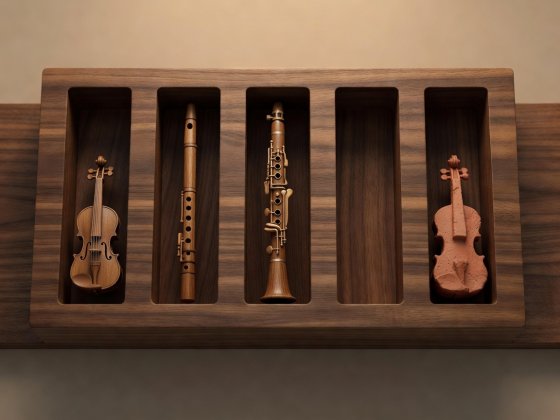
Map every part across register and time before adding a new track.
Use this role diagram to audit your song section by section. Notice how only one element changes (marked in terracotta) at each structural boundary to keep the listener’s focus sharp.
| Functional Role | Primary Register Pocket | Verse 1 Behavior | Verse 2 Evolution | Chorus 1 Full Allocation |
|---|---|---|---|---|
| 1. Lead Focal Line | C4 – G5 (Center Mid-High) | Solo dry lead voice; conversational phrasing | Lead voice + harmony on bar 4 & 8 tail words | Lead shifts up a 4th in range; double or 3rd harmony |
| 2. Foundation (Bass/Kick) | E1 – C3 (Low Octave) | Whole-note root droplets on beat 1 only | Syncopated dotted-quarter figure locking with kick | Driving eighth-note roots + first-inversion passing tones |
| 3. Rhythmic Pulse | C3 – C4 + Transients | Palm-muted acoustic or Rhodes stabs on beats 2 & 4 | Shaker sixteenth-note subdivision added | Open acoustic strum + crisp snare backbeat |
| 4. Harmonic Glue (Pad) | G3 – E5 (Sustained) | Rest (Tacet) — leaves air around lyrics | Rest (Tacet) | Two-note organ or string dyad holding common tones |
| 5. Counter-Line / Fill | G4 – C6 (Interleaved) | Rest (Tacet) | Two-note guitar or synth motif in vocal rests (Bars 2 & 4) | Instrumental hook answers title phrase in Bar 8 |
Place counter-melodies in the gaps where the singer takes a breath.
In Motown arrangements by the Funk Brothers and James Jamerson, or in Stax horn charts, counter-lines almost never step on the lead singer’s active consonant delivery. If the vocal line sings across beats 1, 2, and 3 of Bar 1 and rests throughout Bar 2, Bar 2 is the open window for a piano flourish, a bass walkup, or a three-note horn answer.
The Common-Tone String / Pad Line
Instead of moving all three voices of a pad up and down with every chord change, hold a single high G5 violin or synth note straight across C – Am7 – Fadd9 – G. That stationary ceiling thread binds the whole chorus together.
Subtractive Drop on Chorus 2 or Verse 2
Rather than adding a seventh instrument to create impact, mute the chordal instrument for two bars right after Chorus 1 so only bass, drums, and voice carry the groove.